

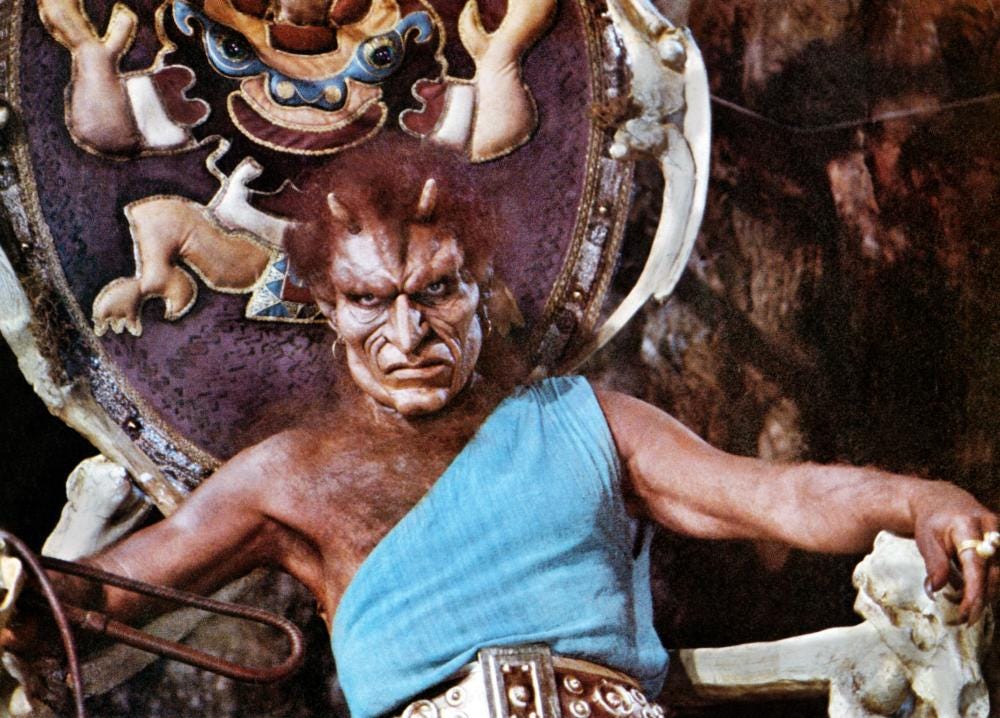
Part man, part special effect, the fiendish Calibos remains one of Ray Harryhausen’s most ambitious cinematic creations, as well as an unlikely template for many monsters who came after him.
Often regarded as Harryhausen’s masterpiece, ‘Clash of the Titans’ saw the effects wizard retire shortly following its release. Apparently, the father of ‘Super-Dynamation’ wanted to go out with the loudest-possible bang. As such, the film is jam-packed with iconic creations, from Bubo the mechanical owl, to the absolutely magnificent Kraken.
However, even among the movie’s menagerie of marvellous monsters, Calibos stands apart.
You see, Calibos is special, because Calibos is human. At least, he was.
In-story, Calibos is actually a demigod. His mother was Thetis, the great Goddess of the oceans, while his father was (presumably) a king. Thetis intended for Calibos to marry the beautiful princess Andromeda, whereupon he would rule the kingdom of Joppa and, eventually, all Phoenicia.
However, a life of luxury and privilege made the young prince arrogant, cold-hearted, and cruel.
As Zeus explains in the movie, “Calibos had every advantage! You (Thetis) as patron Goddess of the rich city of Joppa, have spoiled and indulged him since birth. You let him rule the Wells of the Moon, and what has he done? Hunted and destroyed every living creature! He’s trapped and killed my sacred herd of flying horses, and now only the stallion Pegasus remains. Your son must therefore be punished!”
In a simple, yet memorable sequence, Zeus then moulds a clay statue representing the dark prince into a new, bestial form, bestowing upon Calibos the monstrous, inhuman visage that will plague him for the remainder of his days.
“He will become abhorrent to human sight”, intones Zeus, “He’ll be shunned, and forced to live as an outcast in the swamps and marshes. He’ll be transformed to a mortal mockery, the shameful mark of his vile cruelty. This is my final judgement”.
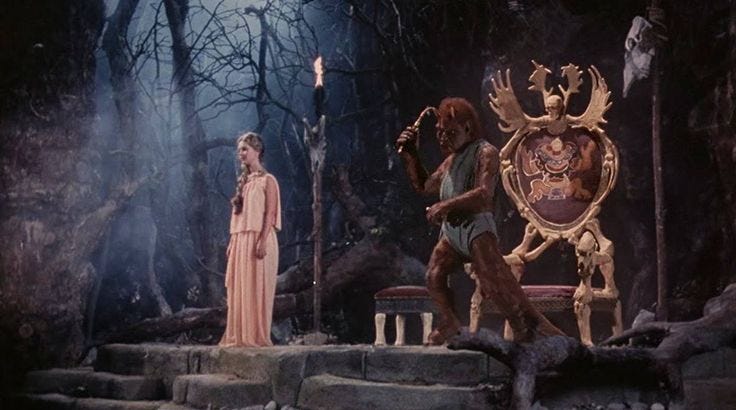
With his outer appearance now reflecting the hideousness within, Calibos becomes overtly tyrannical. He proclaims himself king of the swamplands, and commands all manner of supernatural creatures in a nocturnal court that acts as a feral mockery of Joppa’s lavish palaces.
Andromeda then shuns Calibos (as much for his cruelty, and ever-growing insanity as his appearance). Incensed by this perceived betrayal, Thetis curses the princess (and, by extension, the entire kingdom). Since Andromeda refused to marry Calibos, the curse states, no other man may marry Andromeda.
According to the curse, any man may request the hand of Andromeda. However, upon doing so, each suitor is presented with a riddle created by Calibos himself. If/when the suitor proves unable to solve the riddle, he is burned at the stake - a torturous execution that the otherwise-reasonable people of Joppa reluctantly carry out due to their abiding fear of Calibos.
To impart these riddles, Calibos summons Andromeda’s spirit as she sleeps, trapping it in a cage held aloft by a giant vulture (another cool creature).
After losing his hand during an altercation with the hero Perseus (he replaces it with a razor-sharp trident - something that only adds to his innate coolness), Calibos desperately pleads for his mother’s assistance. Thetis cannot strike at Perseus, however, because the hero is under the protection of his father, Zeus. Instead, Thetis has the people of Joppa offer the princess to the dreaded Kraken as a sacrifice.
In his quest to rescue the princess, Perseus must triumph over the Gorgon known as Medusa, as well as 3 giant scorpions summoned by Calibos, and finally Calibos himself. Perseus ultimately defeats the former prince by plunging his sacred sword through the monster’s twisted black heart.
Unlike other elements of ‘Clash of the Titans’, you won’t find Calibos in any Greek myths. The character was created by screenwriter Beverly Cross, then brought to vivid cinematic life via the genius of Ray Harryhausen.
Although Calibos is an original creation, Cross took a lot of inspiration from Shakespeare’s ‘The Tempest’. In this classic play (probably written in 1610, or 1611), a character named Caliban, who is half-human, half-monster (as well as the son of the sea-witch known as Sycorax), is shunned by humans after he attempts to rape Miranda, daughter of Prospero, the exiled Duke of Milan.
This subhuman monster - one of Shakespeare’s greatest creations - shares many similarities with the cold-hearted, bestial figure of Calibos. Both are borne of magical beings associated with the sea, both attempt to force themselves upon beautiful princesses, and both are shunned by society as a result. Furthermore, both are subject to curses (Calibos by Zeus, Caliban by Prospero).
In a manner perhaps befitting the character’s hybrid nature (on both page, and screen) Calibos is something of a visual chimera. Obviously inspired by the satyrs that appear in Greek mythology, the character is also somewhat Devil-like. These Satanic undertones were never prominent enough to incur the ire of conservative 1980s audiences. However, they were probably detectable enough to keep said audiences slightly scared.
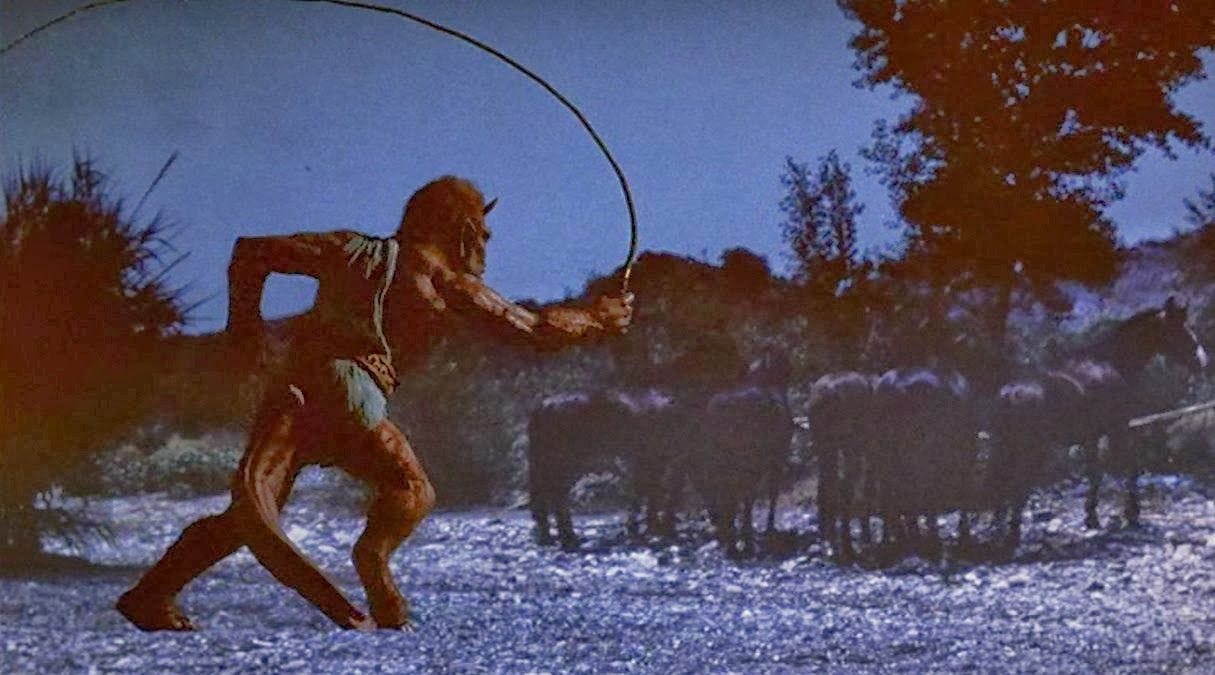
To create Calibos, Harryhausen constructed 2 intricately-detailed models. The largest one stood at around 45CM, and was fashioned from re-purposed parts of another Harryhausen monster (the Troglodyte from 1977’s ‘Sinbad & The Eye of The Tiger’). The smaller model was used for long shots, such as the scenes wherein the monster interacts with Pegasus, or begs Thetis to take revenge against Perseus.
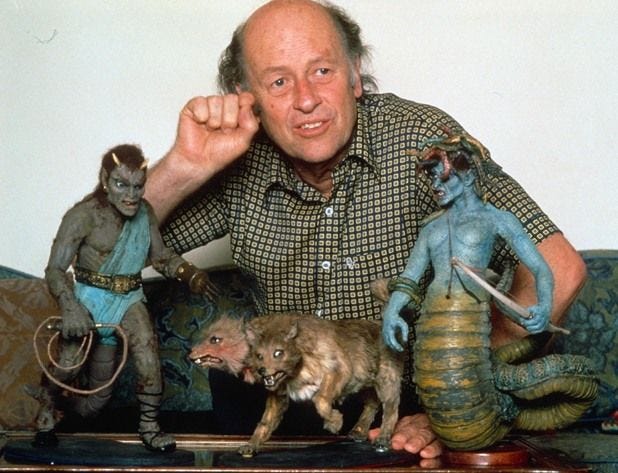
In his autobiography ‘Ray Harryhausen: An Animated Life’ (a book I’m lucky enough to own an autographed copy of), the animator recalls the circumstances that led to Calibos’ curious status as half actor, half stop-motion creature.
“Throughout pre-production the character Calibos was to have been dumb. This was to avoid spending vast amounts of time attempting to animate the model to dialogue. However, just before the final shooting script was written, it was decided that he had to communicate, and after much deliberation the problem was solved by using an actor in Calibos makeup for close-ups when dialogue was required”.
This decision, borne of basic necessity, would prove to be the main aspect that made the character so special.
Actor Neil McCarthy was born in Lincolnshire, in 1932. In his youth, he was diagnosed with acromegaly, a condition that causes parts of the body to grow much larger than usual. As a result, McCarthy had a unique look and physiology which he put to good use as an actor, appearing in everything from ‘Doctor Who’ serials, and episodes of ‘The Avengers’, to critically-acclaimed films such as ‘Zulu’, and ‘Where Eagles Dare’.
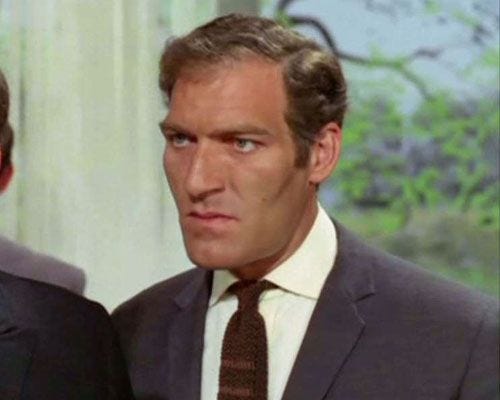
McCarthy was known for his hard, angular features, as well as his tall, imposing physique. These attributes made him the perfect physical specimen to portray Calibos. Sporting prosthetic make-up created by Nick Maley (who had previously worked on ‘The Empire Strikes Back’), McCarthy’s granite-hewn cheekbones, and heavy brow were made to look all the more severe, and fearsome. The actor would have made a convincing monster had he never uttered a single line.
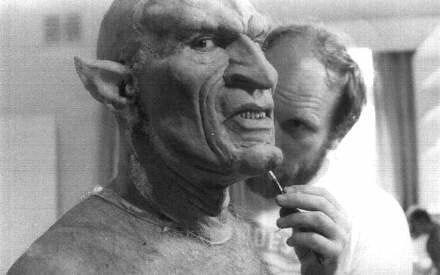
However, in addition to his unusual physicality, Neil McCarthy was also a versatile, highly-capable character actor. He was therefore able to imbue Calibos, not only with the requisite hateful villainy, but also with a sense of pathos that made the character so much more than just another movie monster.
McCarthy seems to have understood the character rather intimately, unearthing a sense of longing, and an abiding sadness in Calibos that is only hinted at by the script.
Calibos is a wealthy, exceedingly-handsome prince - a literal demigod, who finds in a single moment that everything that was ever promised to him has been snatched away, and given to somebody else. Cursed by the Gods, shunned by his bride-to-be, and exiled by the very people he was raised to lead, Calibos endures indignity after indignity. In the depths of this self-inflicted suffering, Calibos finds not humility (as his Shakespearean predecessor ultimately did) but only further motivation for hubris, hostility, and hatred. It is this, not his monstrous countenance, that makes him a villain.
McCarthy’s pleading eyes, and occasionally plaintive vocal delivery added an entirely new dimension to Calibos. No longer merely a ferocious monster, Calibos was now a wretched, contorted soul obsessed with revenge. Once McCarthy was added to the cast, the 3 elements of script, special effects, and performance dovetailed beautifully to create one of the most memorable movie monsters of all time.
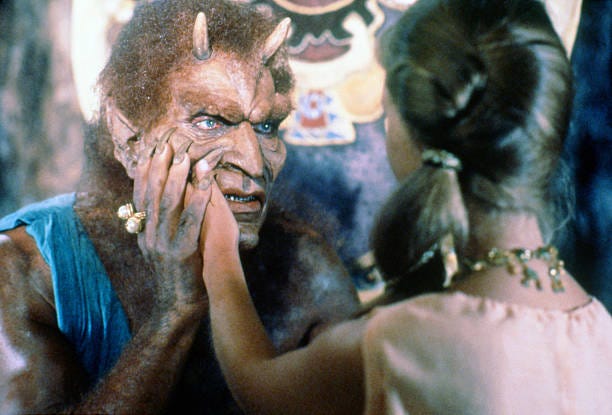
As Harryhausen stated, “As it was the first time a Dynamation character had lines, I was a little apprehensive about whether or not the two extremes of model and actor would work. I needn’t have worried. Neil played the part beyond all expectations, and when seen edited together, Neil and the model blend perfectly.”
Sadly, Neil McCarthy would pass away from motor neurone disease just 4 years after ‘Clash of the Titans’ was released. However, McCarthy’s nuanced, deeply-felt portrayal of Calibos holds up even today. It still feels real, and believable to me, no matter how many times I re-watch the movie.
In 2010, a re-make of ‘Clash of the Titans’ was released. In this (frankly, garbled) retelling, Calibos is depicted as having originally been Acrisius, King of Argos, and (according to the myths) grandfather of Perseus. After he leads a revolt against the Gods, Acrisius is struck by a bolt of lightning from Zeus, whereupon he is deformed, and adopts the more-familiar identity of Calibos. The villainous creature ultimately finds himself in the service of the God Hades, and commits a number of evil deeds before being once again slain by Perseus.
In this version, actor Jason Flemyng performs the role under heavy prosthesis that covers most of his body. The film makes prominent use of CGI effects, but Calibos appears to be rendered via mainly practical means - perhaps a respectful nod in the direction of the original.
Actors in 21st century movies are regularly fused with special effects. Today, it’s a cinematic sight common enough that most audiences barely acknowledge it. However, whenever I see hybrid effects such as these being employed, I often think back to the marvellously inventive work of Ray Harryhausen, and specifically to the character of Calibos. In many ways, Calibos was a pioneer among movie monsters, and it’s doubtful that any number of later filmic creations could have existed without his trailblazing example.
Yes, Calibos was a monster, but he was also a man. He was a stop-motion effect, but he was also an actor imbuing a character with his own heart and soul. Ultimately, Calibos is as much a villainous tyrant as he is a cautionary tale. Drawing upon everything from Greek mythology, to Shakespeare, and even Satan, Calibos tugged at some deeply-buried cultural roots and, as such, got under our collective skin in a way that few villains have been able to do before or since.
© Chris Messenger. All rights reserved.
This article is FREE. Go ahead and enjoy it. If you like what we’re up to here, and you want to see more of The Spoook House, a subscription costs just £3.50 a month.
Alternatively, you can visit Ko-fi.com/chrismessengercreations and leave me a small one-off tip of £3. All donations gratefully received.